Your Next Oracle Fusion Teammate Just Tagged In
For most of the last two years, "AI in ERP delivery" meant a chatbot in a corner of the screen and a copilot that could draft a document if you asked it nicely. Useful, but lonely. Every conversation started from zero. Every team member explained the same project context over and over. The AI never quite became part of the team.
That is starting to change. A new pattern — pairing a channel-based AI teammate with an in-application agentic layer — is reshaping how Oracle Fusion ERP programs get delivered. On one side sits Claude Tag, which lets a team drop an AI teammate directly into a Slack channel and delegate work to it. On the other sit Oracle Fusion Agentic Applications, the prebuilt teams of specialized agents embedded in Oracle Fusion Cloud Applications that take action inside the suite under its own security controls, built and orchestrated through Oracle AI Agent Studio. Put them together and you get something an ERP program has never really had: an AI that reasons across the whole engagement and can act inside the system of record.
Two layers, one teammate
The mental model that makes this click is simple: a brain and a pair of hands.
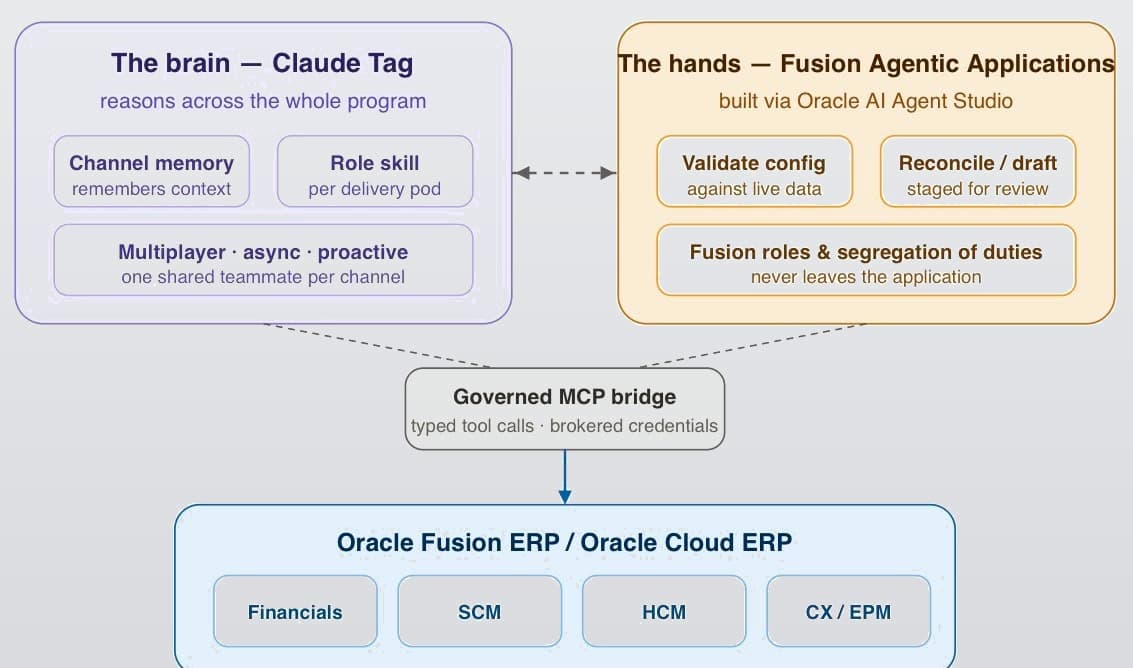
The brain is Claude Tag. It lives where the team already works — in the channels of a collaboration platform — and anyone in the channel can tag it into a task and walk away while it works. Crucially, it remembers. As it follows along in its channel, it builds context about the engagement, so the team stops re-explaining the chart of accounts every Monday. It works asynchronously, breaking a request into stages and grinding through them, and it can even schedule work for itself over hours or days. Because it is multiplayer, there is one shared teammate per channel rather than a private chat per person — so the offshore developer, the onshore functional lead, and the program manager are all collaborating with the same context.
The hands are Oracle Fusion Agentic Applications. These are teams of specialized agents that act inside Oracle Fusion under its role-based access control and segregation-of-duties rules — Oracle's stated direction is for them to reason, decide, and act toward defined business objectives rather than wait passively for instructions. In a finance context, you can imagine agents that help validate account combinations, support reconciliation, categorize expenses, or draft a journal entry for review — illustrative of the pattern, with the exact catalog depending on your Fusion release. The point is that this layer never leaves the application boundary, which is exactly what you want from the thing that touches financial data.
Between them runs a governed bridge. The reasoning layer never holds Fusion credentials and never writes raw SQL. It invokes a curated set of named tools, each one mapping to a specific Fusion agent capability with a defined input and output. The brain decides what needs to happen; the hands do it inside Fusion; the bridge makes sure nothing crosses that isn't allowed.
What this looks like on a real program
Picture an Oracle Fusion implementation organized — as they usually are — into role-based pods: PMO, Finance, Supply Chain, HCM, Technical, Data Migration, Test, Cutover. Give each pod its own channel and its own AI teammate, scoped to that pod's work.
The Finance teammate holds the ledger structure, the legal-entity setup, and every confirmed design decision in its memory. Tag it to draft a functional design from yesterday's workshop transcript and it produces one grounded in the decisions the team already made — then offers to validate the proposed configuration by asking a Fusion agent to test it against sample data inside the application. The Test teammate generates scripts from business process designs overnight and posts a defect summary before the morning stand-up. The PMO teammate scans the project tracker each morning, flags slipping milestones, and drafts the weekly status report on Fridays, pulling live financials through a Fusion agent to ground the numbers.
The shift is subtle but profound. Today, most teams use AI as a vending machine: insert prompt, receive output, repeat. The teammate model turns it into a colleague that accumulates knowledge, takes initiative, and works while you sleep. Anthropic reports that a majority of its own product team's code is now created by its internal version of this pattern — and that delegating to many AI teammates in parallel has become a primary way work gets done. There is no reason an ERP program can't capture the same leverage.
Why the security model is the whole game
Anyone who has implemented Fusion knows the first question a CFO or an auditor asks: who did what, and was it allowed? A teammate that can act inside your ERP only earns trust if that question has a crisp answer.
This is where the brain-and-hands separation pays off. Three identities stay distinct: the human who tags the request, the AI teammate (scoped to its channel), and the least-privilege Fusion service account that the agents actually run as. The teammate can never exceed what that service account permits, and never anything Fusion's own segregation-of-duties rules forbid. Privilege is constrained twice — once at the bridge, once inside Fusion — so a request has to clear both gates.
Writes get extra care. Anything that changes data produces a staged artifact — a draft journal entry, a proposed configuration — that a named human reviews and commits. The AI drafts; a person posts. And because two audit trails exist — one logging every tagged request and the tools it called, one logging every action the agents took in Fusion — you can trace a clean line from "this named person asked in a channel" to "this action happened in the ERP." That end-to-end trace is precisely what client governance and internal audit want to see.
Where to start
You don't roll this out across eight pods on day one. Stand up three channels with the cleanest measurable outcomes — program management, finance, and test — and baseline the effort those teams spend today on status reporting, design generation, and test authoring. Run it for a month. Measure the delta. If the productivity uplift lands where early adopters are seeing it, expand to the full pod model on the next engagement.
The teams that win the next wave of ERP transformation won't be the ones with the most AI tools. They'll be the ones who turned AI into a teammate — one that remembers the program, reasons across it, and acts inside the system of record without ever stepping outside the guardrails. The teammate is ready to tag in. The only question is whether your delivery model is ready to delegate.
Disclaimer: The Oracle Fusion Agentic Applications capabilities described here are illustrative; confirm the current agent catalog and security model against your Oracle Fusion release before designing a pilot.